Articles
How to set up an Osintly organization workspace
Follow the full Osintly organization setup, then see how members, SSO, shared searches, history, credits, billing, and API access work.
By OsintlyRead
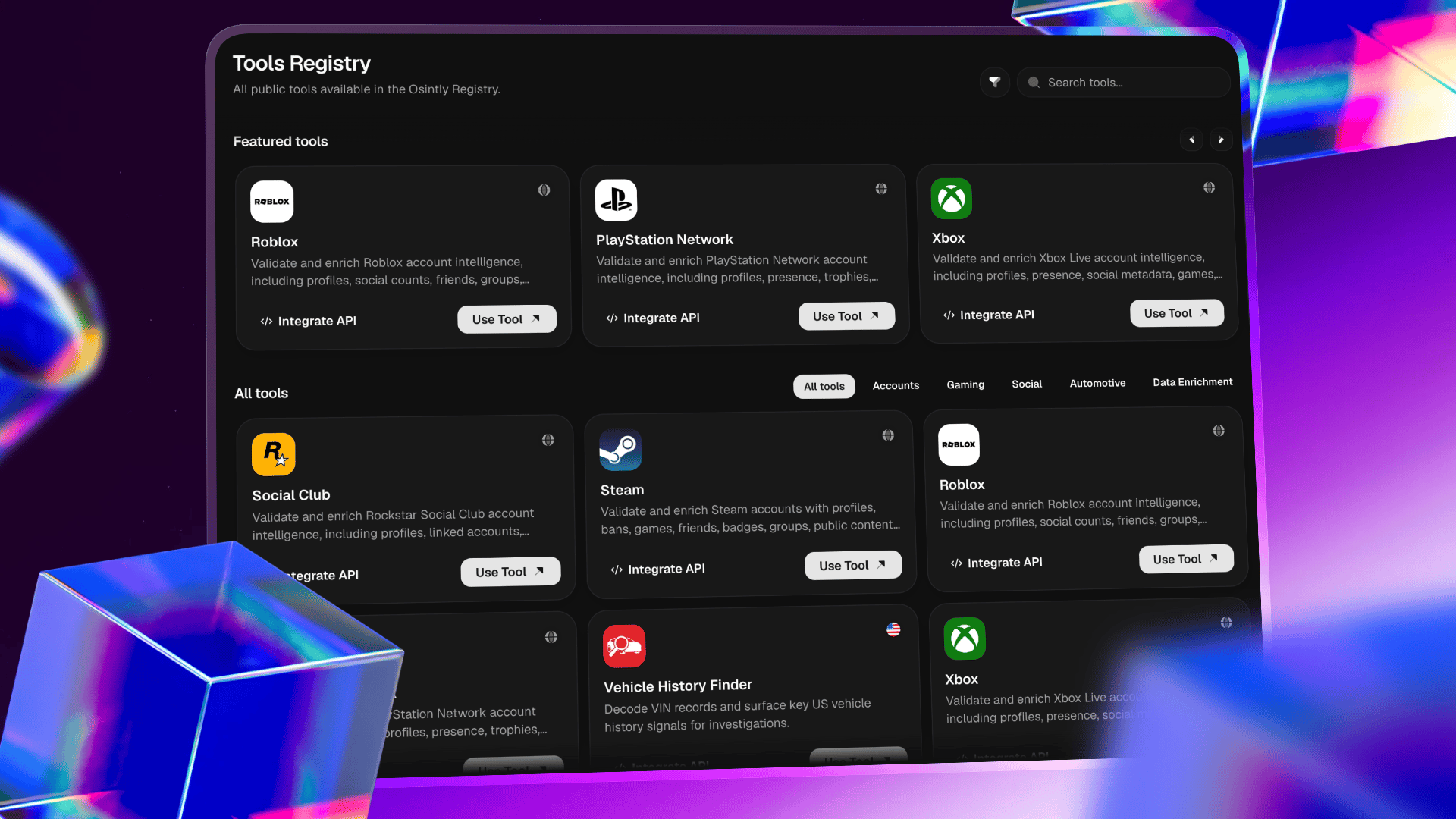
Osintly now gives developers direct API access to seven focused OSINT tools.
You can resolve a gaming identity, inspect public profile signals, enrich a vehicle identifier, or retrieve a complete account snapshot without maintaining a separate integration for every provider. Each tool also has a hosted demo, so you can understand the workflow before writing code.
The Tools API starts at €19 per month. It uses one authentication model, one base URL, normalized JSON responses, and route-level cost discovery.
The current catalog covers six gaming platforms and one vehicle intelligence workflow.
| Tool | What it covers | Hosted demo | API documentation |
|---|---|---|---|
| Epic Games | Account resolution, linked accounts, tags, regions, friends, achievements, creator profiles, and public profile metadata | Try Epic Games | Epic Games API |
| Xbox | Profiles, presence, social signals, linked accounts, games, media, clubs, and title details | Try Xbox | Xbox API |
| Steam | Profiles, aliases, bans, games, friends, badges, groups, public content, statistics, and inventory | Try Steam | Steam API |
| PlayStation Network | Profiles, live presence, trophy summaries, and public game history | Try PlayStation | PlayStation API |
| Roblox | Profiles, social data, friends, groups, games, badges, and collectibles | Try Roblox | Roblox API |
| Social Club | Rockstar profiles, linked accounts, crews, games, achievements, and friends | Try Social Club | Social Club API |
| Vehicle History Finder | US VIN records and French license plate intelligence | Try Vehicle History Finder | Vehicle API |
Browse the full hosted Tools catalog or start with the Tools API overview.
The hosted tools are useful for manual research and for understanding the inputs and results. The API exposes the same focused workflows for products, internal systems, enrichment pipelines, bots, and automated investigations.
Every endpoint lives under:
https://api.osint.ly/toolsAuthenticate with an Osintly API key:
curl -X GET "https://api.osint.ly/tools" \
  -H "Authorization: Bearer $OSINTLY_API_KEY"
Tools share the same bearer authentication, plan checks, rate-limit behavior, and account-level usage system. Read the authentication guide before your first request.
Most tools follow the same pattern:
1. Validate and normalize the submitted identifier with /search.
2. Call a focused route when you only need one signal group.
3. Call /all when you want the main collectors in one response.
4. Add save: true when you need to retrieve the result later.
The validation route does not contact the upstream provider and does not consume core-search credits. Provider-backed routes return the actual enrichment data.
The Epic Games API is more than a display-name resolver.
It accepts nine canonical identifier types:
Aliases such as epic, creator, psn, steam, xbox, and nintendo are normalized automatically.
Start by validating an identifier:
curl -X POST "https://api.osint.ly/tools/epic-games/search" \
  -H "Authorization: Bearer $OSINTLY_API_KEY" \
  -H "Content-Type: application/json" \
  -d '{"value":"some-player","type":"epic_display_name"}'
That request checks and normalizes the input without calling Epic or using credits.
For provider-backed enrichment, choose the smallest route that fits the job:
/resolve resolves the identifier to Epic account data./linked-accounts returns linked platform authentication records./tags returns account tag metadata./regions returns region and language signals./friends-achievements returns friends, achievements, and social counters./creator returns public Fortnite Creator data, social links, and creator islands when available./profile-db returns public profile metadata.When you need the main collectors together, use /all:
curl -X POST "https://api.osint.ly/tools/epic-games/all" \
  -H "Authorization: Bearer $OSINTLY_API_KEY" \
  -H "Content-Type: application/json" \
  -d '{"value":"some-player","type":"epic_display_name","save":true}'
The route costs two core-search credits and charges once for the combined result. With save: true, the response includes meta.savedResult.id, which you can use to retrieve the result later.
The complete route contract, identifier aliases, response behavior, and Creator profile fields are documented in the Epic Games reference.
You can also test the workflow in the hosted Epic Games demo.
You do not have to hardcode tool costs or rely on a pricing table that can become stale.
Each tool exposes a /costs endpoint:
curl -X GET "https://api.osint.ly/tools/epic-games/costs" \
  -H "Authorization: Bearer $OSINTLY_API_KEY"
The response lists the default price and every route pattern with its method, cost type, and quantity. Free validation or detail routes report a quantity of zero. Paid collector routes report their core-search credit cost.
Here, free means zero core-search credit cost after Tools API access is enabled. Tool execution still requires a paid API subscription.
This lets your application check costs before execution, choose a focused route instead of /all, or show expected usage to the user.
The /all route can save a synchronous result when you send save: true. A saved response returns a result ID.
Retrieve it later with:
curl -X GET "https://api.osint.ly/tools/results/<result_id>" \
  -H "Authorization: Bearer $OSINTLY_API_KEY"
Saved results are scoped to the API key and creator that stored them. Another account or key cannot retrieve them.
This is useful when an enrichment needs to be reviewed later, attached to an internal case, or passed to a downstream process without immediately creating a full Osintly search.
Every API subscription currently includes Tools access.
The Builder plan starts at €19 per month and includes:
Growth is available at €49 per month for 3,000 monthly requests, higher rate limits, five API keys, and priority support. Scale is available at €249 per month for 15,000 monthly requests, 15 API keys, and higher production capacity.
Review the live limits and current plan details on the API pricing page. For larger or specialized workloads, contact the Osintly team.
Use the Tools API when you know the observable type and want one direct enrichment response. It has lower workflow overhead and lets you target a specific signal group.
Use the Search API when you need Osintly to coordinate a full investigation. The Search API can:
Both APIs use the same account-level authentication and usage model. You can start with a direct tool today and add full search orchestration when your product needs it.
Compare the two surfaces in the API introduction. Then review the quick start, SSE reference, and webhook guide.
Tool results depend on what the upstream platform exposes publicly and whether the source is available at request time.
A private gaming profile can return partial data. An identifier can be valid even when a provider temporarily returns no enrichment. Combined /all responses may include partialErrors when a secondary collector fails, while still returning the data that was available.
The Vehicle History Finder does not return personal owner data. For French vehicles, full official history remains available through official services such as HistoVec or ANTS.
These boundaries are part of the API contract. Applications should preserve source context, handle null fields and partial errors, and avoid treating an automated result as a final judgment.
Read Osintly's Terms of Use and Ethics Policy before deploying an integration.
1. Explore the hosted Tools catalog.
2. Read the Tools API overview.
3. Review API plans and capacity.
4. Create and secure an API key using the authentication guide.
5. Make your first request with the quick start.
If you are adding OSINT enrichment to a product, analyst workspace, internal tool, or automated workflow, visit the developer overview or talk to our team.
Articles
Follow the full Osintly organization setup, then see how members, SSO, shared searches, history, credits, billing, and API access work.
Articles
Share investigations, results, credits, and alerts with your team. See how Osintly organizations handle access, SSO, exports, billing, and research capacity.
Articles
Run a limited free OSINT search for a username or email on Osintly. Learn what the preview shows, how quotas work, and when to run a full search.

Articles
Learn how Osintly handles search history, data retention, deletion, AI processing, privacy, and responsible OSINT use.Add a short description for the public blog card and search results.
1,550+ ready-to-use OSINT modules covering people, companies, domains, emails, and more.
Everything you need to integrate Osintly into your workflow, from quick start to advanced APIs.
Connect with thousands of OSINT investigators. Share techniques, ask questions, collaborate.
Tutorials, case studies, and insights from our team of open source intelligence specialists.
1,550+ OSINT modules. AI analyst built-in. Real-time data. Everything you need in one place.