Articles
Why use Osintly for your OSINT team?
Share investigations, results, credits, and alerts with your team. See how Osintly organizations handle access, SSO, exports, billing, and research capacity.
By OsintlyRead

The best OSINT API is not the one with the longest feature list. It is the one that returns useful, source-aware evidence, fits your product's search types, and behaves predictably under real traffic.
Developers should compare OSINT APIs across coverage, data structure, documentation, pricing, limits, and operational controls. This guide provides a practical evaluation framework and shows where Osintly's API fits.
An API is only useful if it accepts the starting points present in your cases. Common inputs include:
Osintly supports six core search types and more than 1,550 modules. Its separate Tools API adds focused gaming and vehicle workflows. Browse the live module catalog and hosted tools to compare that coverage with your requirements.
Create a test set from lawful data you control. Include valid matches, ambiguous inputs, missing profiles, malformed values, and regional variations.
A high match count can hide low-quality output. Inspect whether each result provides:
Your application should distinguish public profiles, registration indicators, breach records, leak records, and inferred links. Combining them into one confidence score without context makes results harder to explain.
The Osintly search API lets email workflows enable registered-account and breach checks independently. Module UUID selection also lets teams define a controlled source set.
Before choosing a provider, ask an engineer who did not attend the sales call to build a small integration. Good documentation should make these tasks straightforward:
1. Authenticate from a backend service.
2. Submit a search.
3. receive progress or completion.
4. Retrieve structured results.
5. Interpret partial failures.
6. Estimate the cost before scaling.
Osintly documents bearer authentication, the search request schema, Server-Sent Events, webhooks, and search retention.
For targeted enrichment, the Tools API reference lists each route and its credit cost.
Pricing pages often mix several units. Translate every plan into your expected monthly workload.
For Osintly, API plans include monthly and daily request allowances, per-minute rate limits, API-key limits, concurrency, and burst capacity. At the time of writing:
| Plan | Monthly price | Monthly requests | Daily requests | Requests per minute |
|---|---|---|---|---|
| Builder | €19 | 500 | 30 | 10 |
| Growth | €49 | 3,000 | 150 | 30 |
| Scale | €249 | 15,000 | 750 | 120 |
Plans also differ in API keys, concurrency, burst capacity, and support. Always confirm the current figures on the API pricing page.
Tools routes have their own published credit costs. A route marked free uses no core-search credit, but it still requires a paid API plan with access to Tools. Use each tool's /costs endpoint or documentation when estimating spend.
A hosted demo reduces integration risk. It lets investigators see the data, choose useful fields, and identify interpretation issues before engineering commits to a schema.
Osintly offers hosted tools for:
The same workflows have documented API routes in the Tools reference. This manual-to-API path is valuable because your analysts and developers can discuss the same output.
OSINT depends on external sources. Public visibility changes, provider APIs evolve, and some fields may be unavailable for a specific account.
Look for an API that:
Your interface should show missing data as unavailable, not false. Log enough metadata to debug a request, but never log access tokens or unnecessary sensitive data.
At minimum:
Osintly is hosted in Europe and exposes REST and SSE interfaces. Review the platform overview, authentication guide, and retention documentation with your security and legal teams.
Score each candidate from one to five:
| Category | Questions |
|---|---|
| Coverage | Does it accept your real starting identifiers? |
| Evidence | Are sources, timestamps, and stable IDs preserved? |
| Structure | Can responses be normalized without scraping prose? |
| Reliability | Are partial failures and retries handled clearly? |
| Documentation | Can a developer integrate without private guidance? |
| Pricing | Can you model cost from published units and limits? |
| Security | Are keys, callbacks, and retention controllable? |
| Validation | Is there a hosted demo or sandbox? |
Weight the categories based on your product. A fraud team may prioritize speed and linked accounts. A research platform may prioritize source fidelity and retention.
Using one API for several search types reduces authentication code, vendor-specific adapters, billing surfaces, and monitoring work. It also makes it easier to enforce consistent evidence and safety rules.
Osintly combines a broad module-based search API with focused Tools for gaming and vehicle intelligence. Start by exploring the hosted platform, browse the module catalog, test the hosted tools, and read the developer documentation.
The right provider is the one that performs well on your own lawful test set. Build a small proof of concept, measure useful evidence per request, and estimate the total engineering and operational cost, not only the headline subscription price.
Articles
Share investigations, results, credits, and alerts with your team. See how Osintly organizations handle access, SSO, exports, billing, and research capacity.
Articles
osint.rocks says it is taking a break. Try Osintly's free username and email search previews, plus a free Google OSINT alternative to GHunt.
Articles
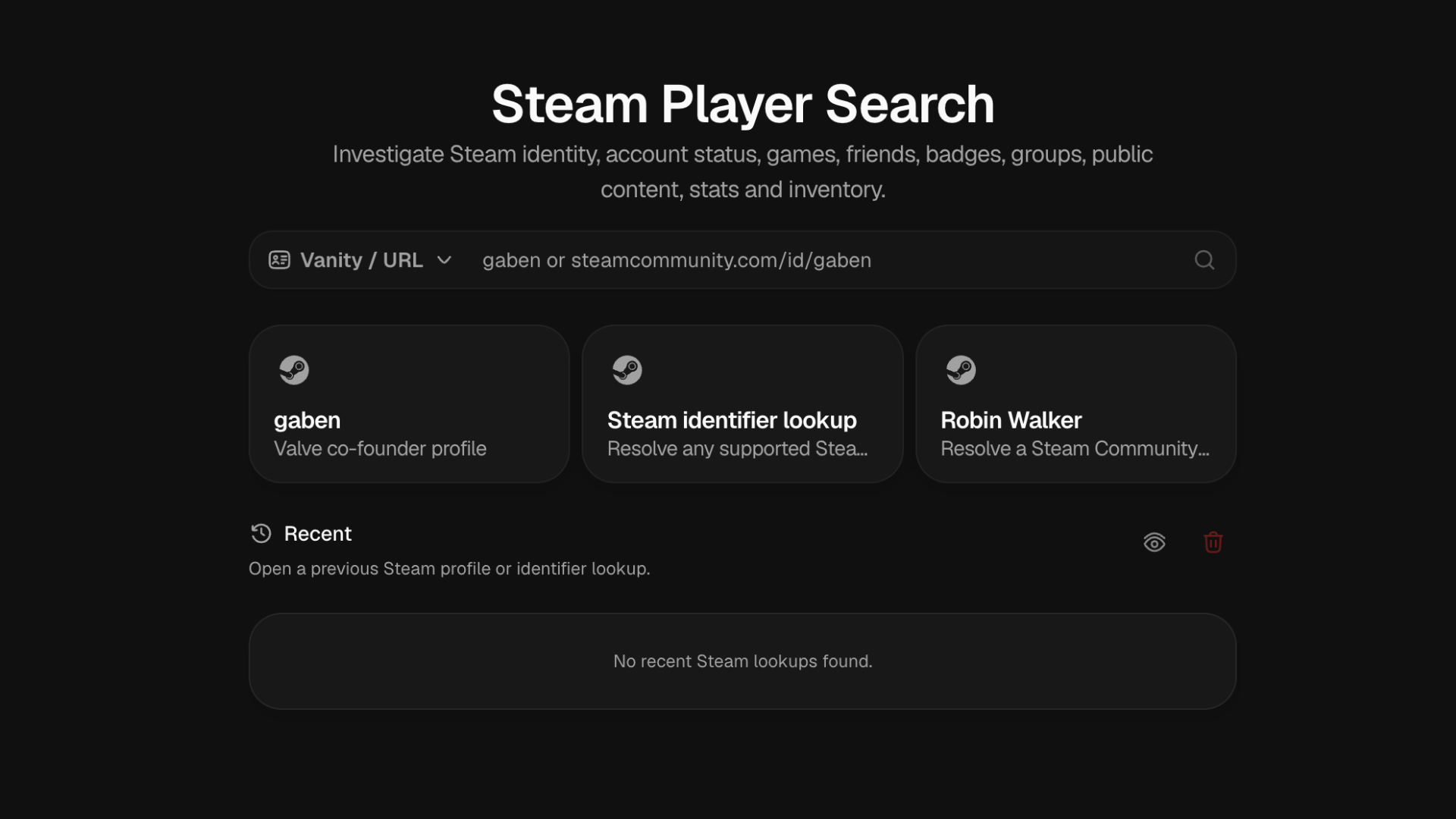
Investigate public Steam profiles, games, friends, bans, groups, badges, stats, content, and inventory through a hosted tool and API.
Articles
Follow the full Osintly organization setup, then see how members, SSO, shared searches, history, credits, billing, and API access work.
1,550+ ready-to-use OSINT modules covering people, companies, domains, emails, and more.
Everything you need to integrate Osintly into your workflow, from quick start to advanced APIs.
Connect with thousands of OSINT investigators. Share techniques, ask questions, collaborate.
Tutorials, case studies, and insights from our team of open source intelligence specialists.
1,550+ OSINT modules. AI analyst built-in. Real-time data. Everything you need in one place.