Articles
Roblox OSINT: Username, Groups, Games and Collectibles
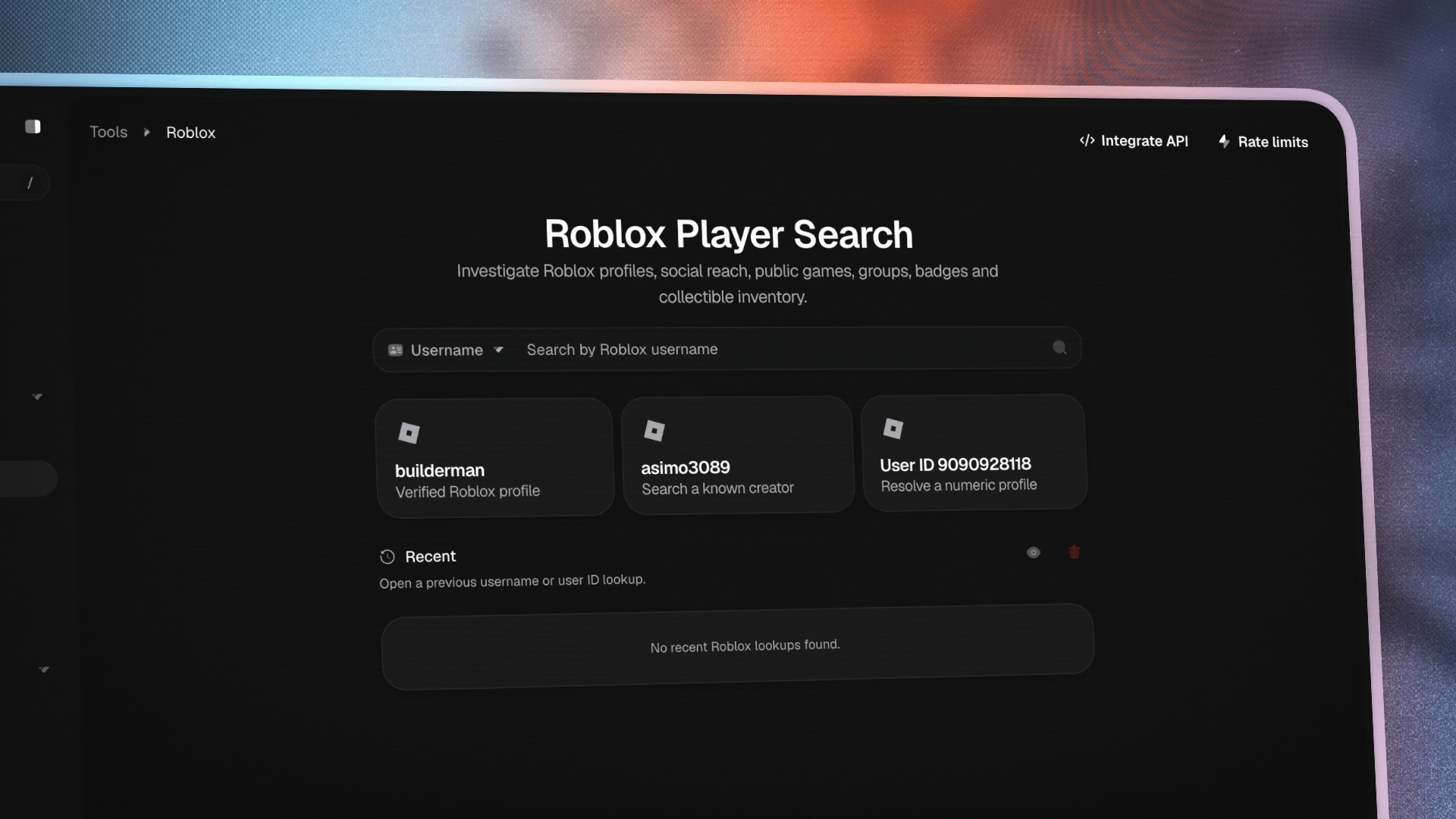
Resolve Roblox usernames and investigate public profiles, social connections, friends, groups, games, badges, and collectibles through one API.
By OsintlyRead
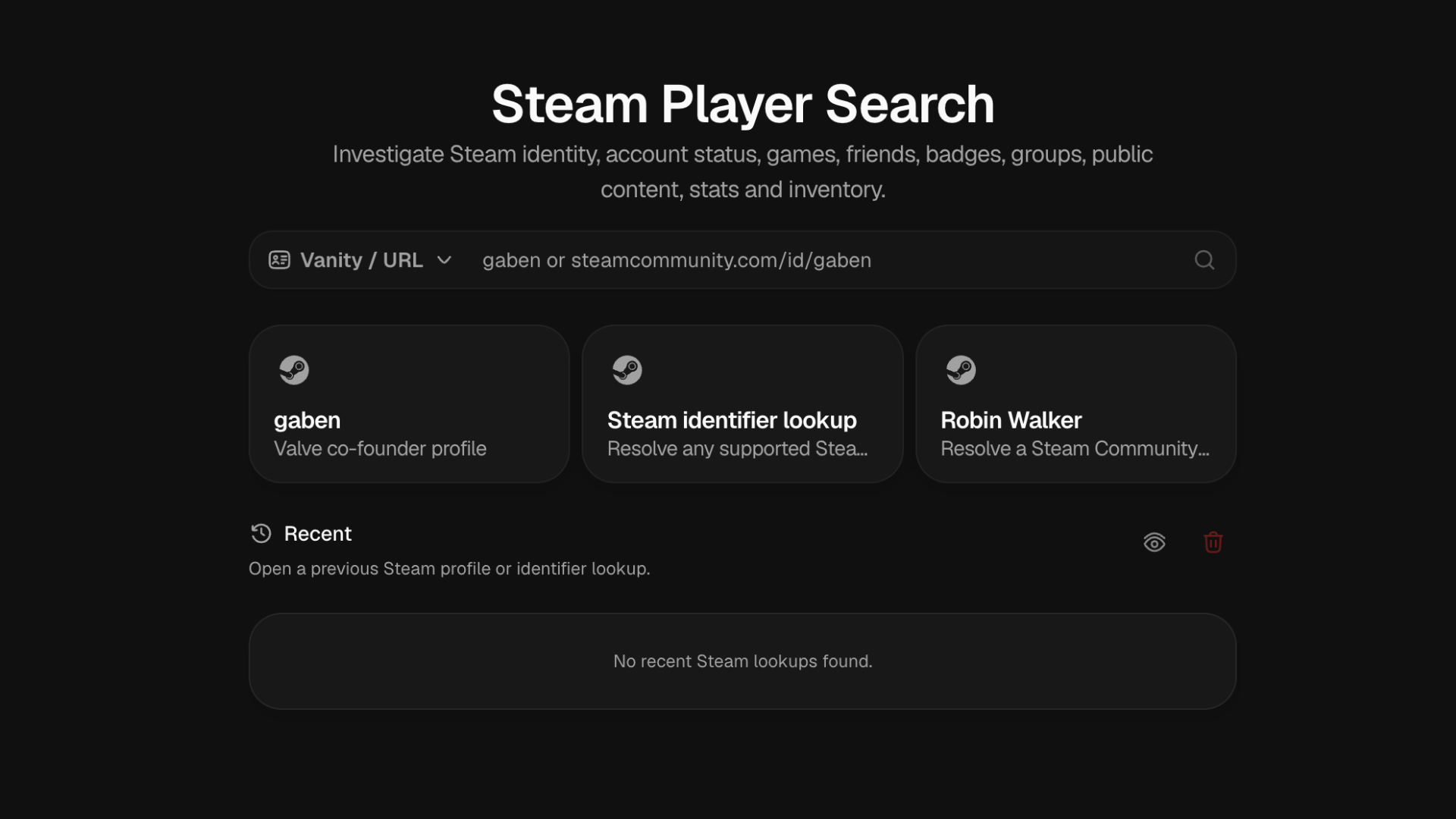
A Steam profile can expose far more than a display name. Depending on public visibility, investigators may find stable identifiers, profile details, game libraries, friends, bans, groups, badges, statistics, published content, and inventory data.
Osintly packages those pivots into a hosted Steam OSINT tool and a documented Steam developer API. The hosted tool is useful for manual validation. The API is built for repeatable application workflows.
Only investigate accounts when you have a lawful purpose and appropriate authorization. Public profile data should be treated as evidence, not automatic real-world attribution.
The Steam tool accepts several common forms:
SteamID64 is usually the best stable key for your database. Vanity names can change, and different user interfaces may display different formats for the same account.
A good workflow resolves the input first, stores the original value, and associates every later observation with the resolved SteamID64.
Open the Steam tool and test an identifier you are authorized to investigate. The interface helps you see which sections are public and which route fits your product.
Manual testing answers important schema questions:
Once the output is useful, move to the Steam API reference.
Search is a free validation route, meaning it does not consume a core-search credit. Resolve costs one credit and converts the supplied identifier into the stable account representation used by later routes.
curl --request POST \
  --url https://api.osint.ly/tools/steam/resolve \
  --header "Authorization: Bearer $OSINTLY_API_KEY" \
  --header "Content-Type: application/json" \
  --data '{
    "identifier": "example_player"
  }'
Use the exact payload shown in the current Steam documentation. Keep the bearer token on your backend and follow the authentication guide.
The profile route costs one credit and returns the public profile fields available for the resolved account. The bans route also costs one credit and separates ban-related evidence from general profile metadata.
Keep bans in their own data structure. A ban has a specific scope and timestamp context. Do not turn it into a broad claim about the person behind an account.
The games route costs one credit and can provide a public library or playtime context when the profile exposes it. Game detail is a free follow-up route. Statistics cost one credit.
Useful questions include:
Visibility settings matter. A missing game list does not mean the account owns no games.
Friends, groups, and badges each cost one credit. Group detail is a free follow-up route.
Connections can support a hypothesis, but they are not all equally meaningful. A friend may be a close contact, a one-time teammate, or an automated account. Group membership may indicate a community, language, game, or theme without identifying a person.
Preserve the network as observations:
type SteamRelationship = {
  sourceSteamId: string;
  relationship: "friend" | "group_member";
  targetId: string;
  observedAt: string;
};
Avoid labeling a relationship as personal unless independent evidence supports that conclusion.
Published content costs one credit. Inventory lookup costs one credit, while inventory-detail is a free follow-up route.
These surfaces may reveal public workshop activity, screenshots, collections, or visible items. They can help distinguish accounts with similar names, especially when combined with stable IDs and consistent activity.
Inventory visibility can be private. Design your UI to distinguish private, unavailable, empty, and failed responses.
The all-in-one Steam route costs three credits. It is convenient for analyst-led research or a first broad snapshot.
For high-volume products, focused routes may be cheaper and easier to cache. Use the cost documentation and the Tools API /costs endpoint before choosing your collection plan.
The Tools API also supports save: true. Saved output can be retrieved later through the result endpoint documented in the Tools API introduction.
Steam visibility and provider behavior vary by account. A resilient integration should:
1. Resolve the account.
2. Store the stable SteamID64.
3. Call only the routes required by the case.
4. Preserve successful sections even if another route fails.
5. Record timestamps and route-level errors.
6. Avoid interpreting unavailable data as a negative result.
7. Apply bounded retries to temporary failures.
Never expose your API key in a browser or game client. Redact credentials from logs and separate development from production keys.
Steam is often one part of a larger identity. After finding a credible public link, you can continue with the hosted Epic Games, Xbox, PlayStation Network, Roblox, or Social Club tools.
For implementation, start with the Steam hosted demo, review every route in the Steam API documentation, confirm the current API plans, and use the Tools API introduction for shared authentication, costs, and saved results.
Articles
Resolve Roblox usernames and investigate public profiles, social connections, friends, groups, games, badges, and collectibles through one API.
Articles
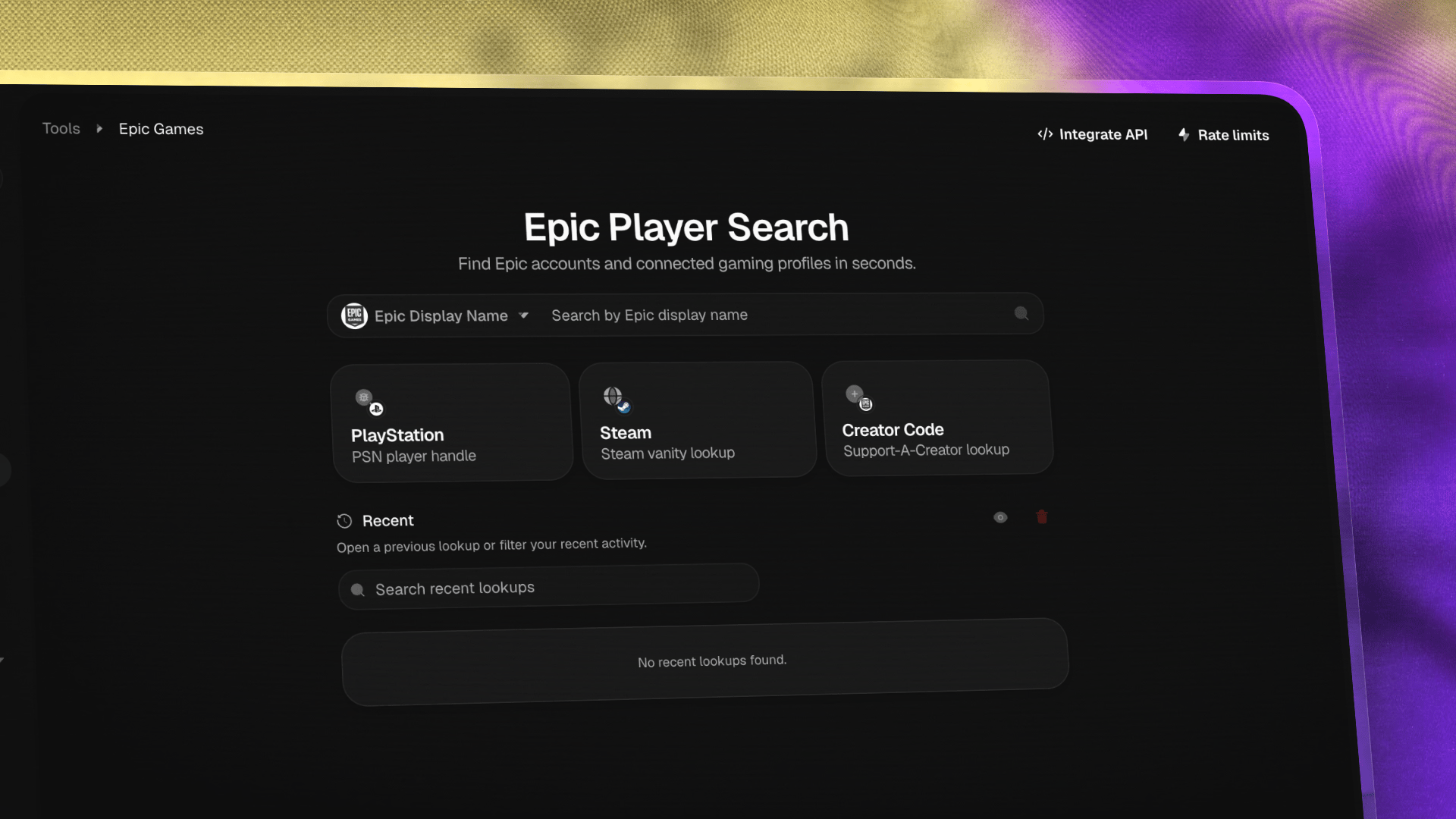
Search Epic Games identities, resolve account IDs, and investigate linked gaming accounts with a hosted tool and developer API.
Articles
Share investigations, results, credits, and alerts with your team. See how Osintly organizations handle access, SSO, exports, billing, and research capacity.
Articles
osint.rocks says it is taking a break. Try Osintly's free username and email search previews, plus a free Google OSINT alternative to GHunt.
1,550+ ready-to-use OSINT modules covering people, companies, domains, emails, and more.
Everything you need to integrate Osintly into your workflow, from quick start to advanced APIs.
Connect with thousands of OSINT investigators. Share techniques, ask questions, collaborate.
Tutorials, case studies, and insights from our team of open source intelligence specialists.
1,550+ OSINT modules. AI analyst built-in. Real-time data. Everything you need in one place.