Articles
Why use Osintly for your OSINT team?
Share investigations, results, credits, and alerts with your team. See how Osintly organizations handle access, SSO, exports, billing, and research capacity.
By OsintlyRead
OSINT stands for open source intelligence. It is intelligence produced by collecting and analyzing publicly or commercially available information to answer a specific question. The U.S. Intelligence Community's OSINT strategy uses that distinction: accessible information is the material; intelligence is the result of working with it.
That question can be small: is this seller account linked to an older marketplace profile? It can also be larger: which work email addresses appear in reported breaches? You start with a lead, collect relevant information, verify it, and explain what the evidence supports.
In OSINT, "open source" describes the information's availability. It does not mean the source code of a software project.
Typical sources include:
A source does not need to be free to count. A subscription database of published records can be an open source. Access conditions, licensing, and applicable law still matter. A publicly reachable page is not automatic permission to collect or republish everything on it.
A list of 40 accounts sharing a username is raw information. It becomes useful intelligence when you assess which matches are supported, distinguish unrelated accounts, and explain how the findings answer your question.
Verification matters because common usernames can belong to unrelated people, profiles become outdated, and a record from a 2019 breach does not establish what is true today. Even a stable account ID identifies an account; linking that account to a person needs separate evidence.
The practice predates the web. The U.S. National Archives records the creation of the Foreign Broadcast Monitoring Service on February 26, 1941, to monitor, transcribe, and analyze foreign broadcasts. That is a historical example of the practice, not a date for the invention of the term OSINT.
The internet expanded the range of material available for this work, from public profiles to searchable records and infrastructure data.
A practical workflow is:
1. Define the question. "Find everything about this person" is too broad. "Is this email address connected to the account that contacted our support team?" gives you something to test.
2. Collect. Choose sources that could answer it, such as public profiles, account-presence signals, or domain records.
3. Verify. Check original sources, dates, account IDs, and corroborating details. Record conflicting evidence.
4. Analyze. Explain the connections, their strength, and alternative interpretations.
5. Report. Record what you found, where, when, and with what confidence. Leave open questions open.
A finding can become another lead. An email may surface a username, and a profile may link to a personal domain. Each connection still needs checking.
Accessing someone else's private account without permission, attacking passwords, or deceiving support staff into disclosing private information is not public-source collection.
Public information can still be personal data. Where the GDPR applies, organizations need an appropriate legal basis and must respect duties such as data minimization, security, and retention limits. The EDPB's guidance explains these principles. Public availability alone does not settle whether a particular use is lawful.
Osintly Search brings together supported sources for identifiers such as usernames and email addresses. Coverage depends on the identifier, plan, selected modules, and source availability. For infrastructure research, use Domain Intelligence or IP Intelligence.
You can start with a limited free preview for a username or email without creating an account. It may use cached data and stays available in the same browser session for 15 minutes. The free preview guide explains the limits. Treat each result as a lead to verify.
Articles
Share investigations, results, credits, and alerts with your team. See how Osintly organizations handle access, SSO, exports, billing, and research capacity.
Articles
osint.rocks says it is taking a break. Try Osintly's free username and email search previews, plus a free Google OSINT alternative to GHunt.
Articles
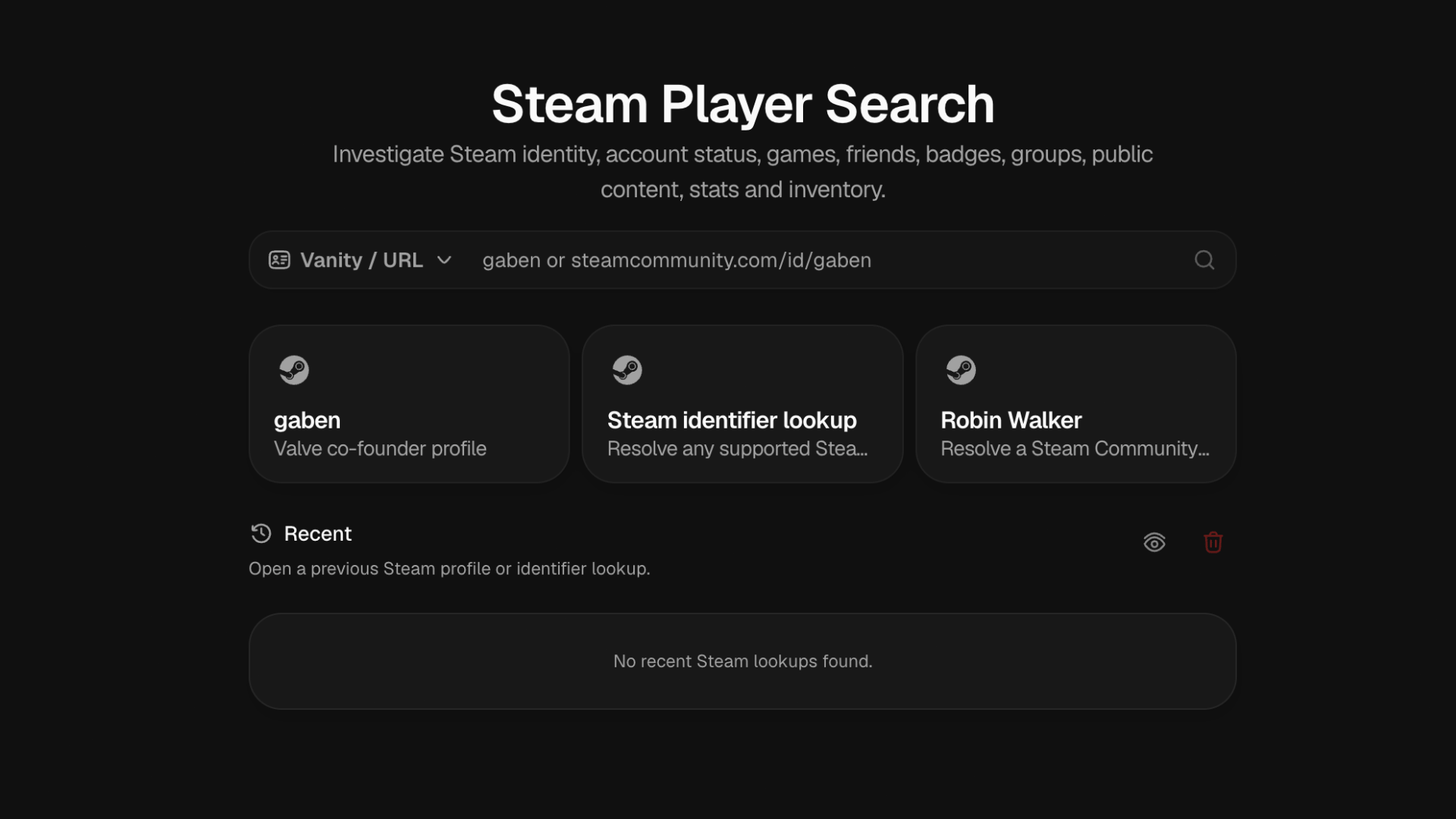
Investigate public Steam profiles, games, friends, bans, groups, badges, stats, content, and inventory through a hosted tool and API.
Articles
Follow the full Osintly organization setup, then see how members, SSO, shared searches, history, credits, billing, and API access work.
1,550+ ready-to-use OSINT modules covering people, companies, domains, emails, and more.
Everything you need to integrate Osintly into your workflow, from quick start to advanced APIs.
Connect with thousands of OSINT investigators. Share techniques, ask questions, collaborate.
Tutorials, case studies, and insights from our team of open source intelligence specialists.
1,550+ OSINT modules. AI analyst built-in. Real-time data. Everything you need in one place.