Articles
Why use Osintly for your OSINT team?
Share investigations, results, credits, and alerts with your team. See how Osintly organizations handle access, SSO, exports, billing, and research capacity.
By OsintlyRead

We have been heads down for the past few weeks, talking through what Osintly looks like next. This post is the result of those conversations.
Osintly started as a single input. Pseudonym, Email Address, IP, Domain, Crypto, all going into one search box, all returning results in the same page. That was the right call early on. It is still the right call for most of what people search.
But we are starting to hit a ceiling, and it shows in two places.
1. First, the modules themselves. When everything lives behind one universal input, modules end up stepping on each other. A domain lookup and a crypto trace do not need the same UI, the same filters, or the same depth of result. Forcing them into the same shape makes both worse.
2. Second, the search experience. The more input types and the more modules we add to a single box, the harder it gets to make any one of them genuinely best-in-class. You end up optimizing for "works okay everywhere" instead of "this is the best tool for this specific job." (IP and domain lookups inside Osintly today are a good example of that.)
So that is the constraint we are designing against: keep the unified workspace, but stop treating every search type the same way.
The current input handles six types: pseudonym, email, phone (not active), IP, domain, crypto.
Going forward, the main search input narrows to four: pseudonym, name, email, phone number. These are the identity-centric searches, the ones people run most often, and the ones where a single unified input genuinely makes sense.
Domain, crypto, and everything adjacent to them moves into a new section we are calling Tools.
Tools will be a new category inside Osintly, built around standalone, single-purpose OSINT utilities. Domain lookups, crypto address tracing, and the other non-identity searches will move here first, each with its own interface designed around what that specific lookup actually needs instead of being squeezed into the universal search format.
If you have used something like epicgames.tools, the idea is similar: a focused tool that does one job well, with its own page, its own layout, its own logic. The difference is that instead of being scattered across separate one-off sites, every one of these lives inside Osintly, under the same account, the same credit system, the same correlation engine as the rest of your investigation.
This is also where we expect to move fast. A new Tool can ship without touching the core search experience (Tools will not be modules), which means we can cover a lot more ground, a lot more specifically, than trying to cram everything into one input.
The second shift is the one we are most cautious about.
We are building toward an AI that does not just analyze results after the fact, it runs the search itself: picking which modules or tools to use, in what order, based on what the target is and what the early results suggest. Think of the agentic search approach SherlockEye and other platforms have been exploring, applied on top of the module library and the new Tools library we are building out underneath it.
We want to be upfront about what this is and is not. AI is not deterministic, and we know a lot of people, OSINT investigators especially, are rightly skeptical of handing search logic over to something that will not always behave the same way twice. We are not replacing the core search with this. The standard search stays exactly as reliable and predictable as it is today, and AI Analyst is not going anywhere either.
The "AI orchestrator" is a test. We think it is one of the better ways to represent how an investigation actually unfolds, ask a question, let the system figure out where to look next, get something coherent back instead of raw results to sort through manually. But it earns its place next to the existing search, not instead of it.
Not everything survives the rebuild in its current form.
Projects and Teams are getting simplified around the new core instead of existing as separate, parallel features. Less surface area, fewer places to manage the same investigation. We will share specifics once that lands.
To be clear about where we are: this is a direction, not a changelog. We are working on bringing these pieces to life over the coming weeks, and we will keep shipping and writing about it as it happens, the same way we always have.
The goal has not changed since day one. Every search type, best-in-class. We are just being honest that getting there means breaking the all-in-one box open, not making it bigger.
EstePrime, Founder of Osintly
Find us at https://osint.ly
Articles
Share investigations, results, credits, and alerts with your team. See how Osintly organizations handle access, SSO, exports, billing, and research capacity.
Articles
osint.rocks says it is taking a break. Try Osintly's free username and email search previews, plus a free Google OSINT alternative to GHunt.
Articles
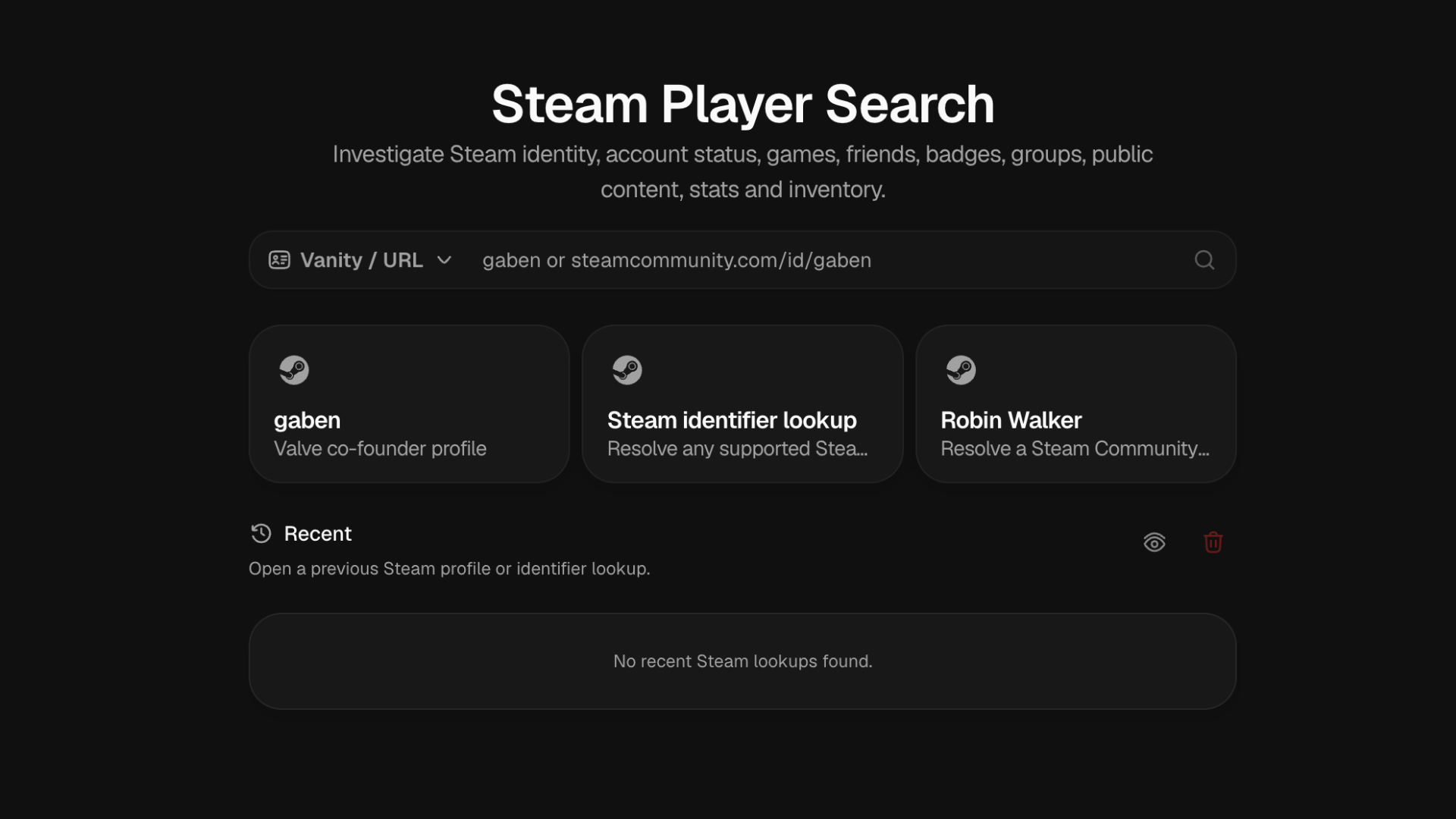
Investigate public Steam profiles, games, friends, bans, groups, badges, stats, content, and inventory through a hosted tool and API.
Articles
Follow the full Osintly organization setup, then see how members, SSO, shared searches, history, credits, billing, and API access work.
1,550+ ready-to-use OSINT modules covering people, companies, domains, emails, and more.
Everything you need to integrate Osintly into your workflow, from quick start to advanced APIs.
Connect with thousands of OSINT investigators. Share techniques, ask questions, collaborate.
Tutorials, case studies, and insights from our team of open source intelligence specialists.
1,550+ OSINT modules. AI analyst built-in. Real-time data. Everything you need in one place.