
Announcements
Introducing the Osintly Logo Service
Fetch domain logos as images via a simple GET request. No auth, CORS enabled, served from the edge.
By OsintlyRead
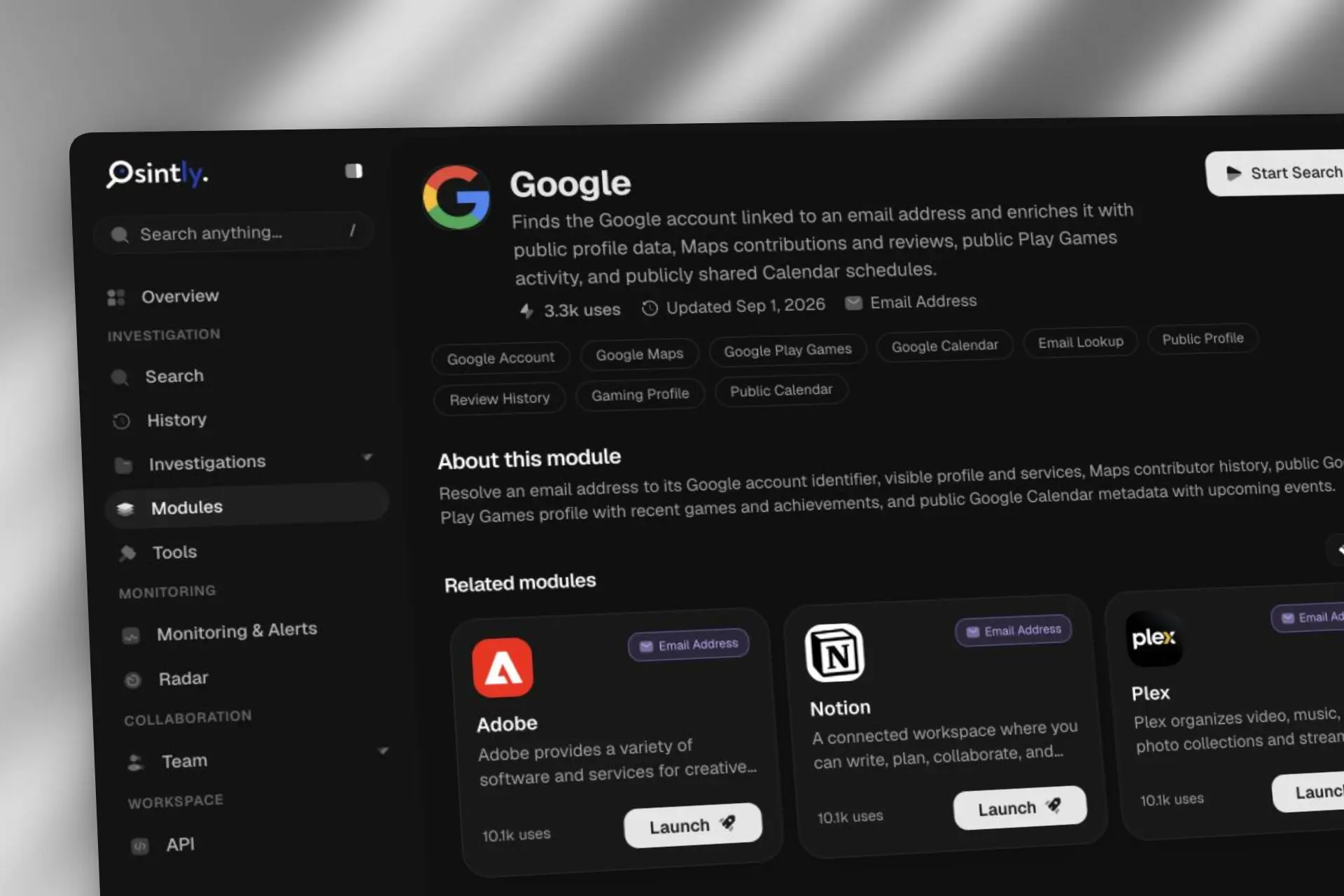
An email address is one of the best starting points for an online investigation, but the quality of the result depends on how many sources are checked and how well those results are connected. A basic account-existence check can confirm that an address is in use. A useful email OSINT search should also show what is publicly attached to it, where the account has appeared, and which findings are worth following.
We have expanded email search on Osintly to more than 50 published modules. The largest addition is a rebuilt Google module, which now reaches well beyond the small set of fields returned by most Google account lookup tools.
Many Google email lookups stop after finding an account identifier, a profile image, or a Maps contributor page. Those fields are helpful, but they leave much of the public Google footprint unexplored.
The current Osintly module resolves an email address to its Google account and organizes the available public data into investigation-ready results. Depending on what the account exposes, a search can return:
The important change is not simply the number of fields. Maps reviews, gaming activity, and shared calendar data are returned as structured, source-linked cards inside the same result model as the rest of an Osintly search. Investigators can review the original source, compare dates, and use a finding as a pivot without rebuilding the result by hand.
Public visibility still sets the boundary. A private Play Games profile or a calendar that has not been shared will not produce the same detail as an account with a larger public footprint. Results can also change when Google updates its services or rate limits upstream access. The module page shows its current scope, version, and last update date so that coverage is easy to verify.
GHunt deserves credit for making Google account OSINT more accessible. It established a workflow that many investigators still recognize, and its repository continues to receive maintenance fixes. Calling it abandoned would be inaccurate; its commit history shows recent work.
What has aged is the narrower field set that many third-party services still associate with a “GHunt lookup.” We know that some platforms are based on GHunt or closely mirror its historical output. In practice, that often means the investigation ends around an account ID, profile information, Maps data, or a limited selection of connected services.
Osintly's Google module is not limited to that older output. It adds richer Maps review records, detailed Play Games data, public Calendar schedules and events, normalized dates, and direct links back to the source. It also runs as part of a broader email investigation instead of as an isolated Google check.
Based on the public fields covered today, we believe this is the most complete Google account enrichment available in a hosted email OSINT platform. The claim is easy to inspect rather than take on faith: the current coverage is listed on the Google module page, and the module's output is presented directly in each search result.
Google is the main release, but a single source should not carry an entire investigation. An Osintly email search brings together platform-specific modules, account registration checks, breach sources, profile images, and geographic context in one result.
Each part answers a different question:
| Result area | What it is useful for |
|---|---|
| Osintly modules | Public profiles and platform-specific details such as IDs, usernames, dates, activity, locations, and source links. |
| Registered Accounts | A quick view of the services where the email appears to have an account. |
| Breached Accounts and Leaked Results | Historical exposure in supported breach and leak sources, kept separate from current public profiles. |
| Profile Pictures | Images associated with the address across supported services, useful for careful visual correlation. |
| Geographic Distribution | A map built from locations found in the returned records. |
The result counts in the screenshot are from an anonymized example and will vary by address, selected modules, source availability, and account privacy settings.
You can browse every published option in the Email Address module catalog. Modules can be selected individually when an investigation needs a narrow scope, or combined for wider coverage.
The Registered Accounts category is intentionally separate from rich module results. It checks supported services for evidence that the searched email is registered and presents the positive matches in a compact list.
This is useful at the beginning of an investigation. It shows which services are worth examining before a public profile is available, and it can reveal a cluster of accounts that would be easy to miss when checking platforms one by one. A positive registration signal does not prove who controls the account, so it should be treated as a lead and corroborated with the richer records returned by modules.
Registered account checks are also available through the API. The search endpoint documentation describes include_registered_accounts for adding them to a normal search and registered_accounts_only for an email-only existence scan. The result data model explains how registered_accounts, module cards, breached accounts, and leaked data are separated in the response.
Start with the Google email lookup, review the wider email module catalog, or open a new search and choose the coverage you need. Teams building the same workflow into an internal tool can use the Osintly API documentation.
All results depend on what the source makes publicly accessible at the time of the search. Use them as investigative leads, keep the original source attached, and corroborate important findings before drawing a conclusion.
Announcements
Fetch domain logos as images via a simple GET request. No auth, CORS enabled, served from the edge.
Announcements
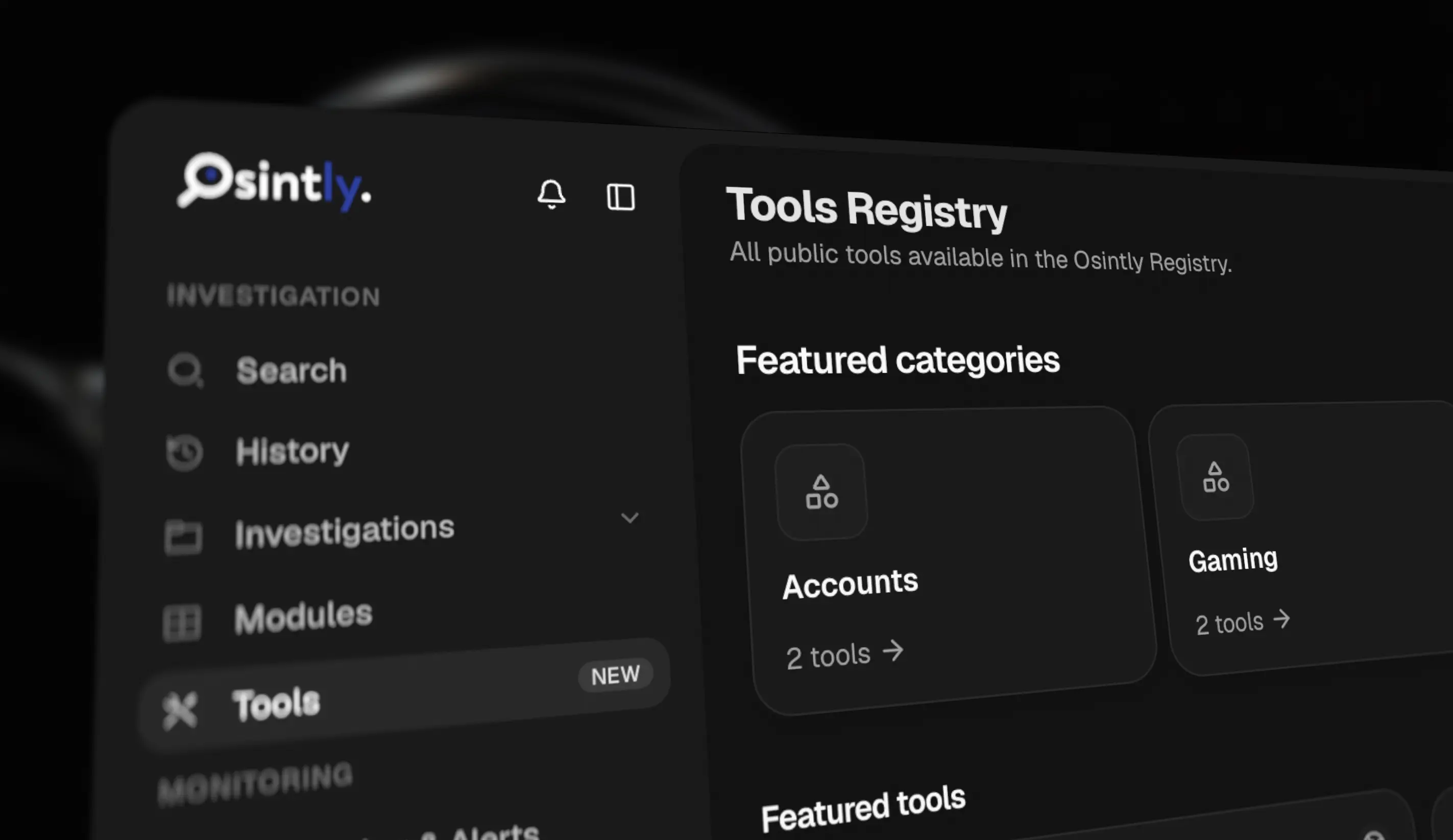
We now have two major gaming tools live on Osintly, Epic Games and Xbox. Here's why that matters more than it looks.
Announcements
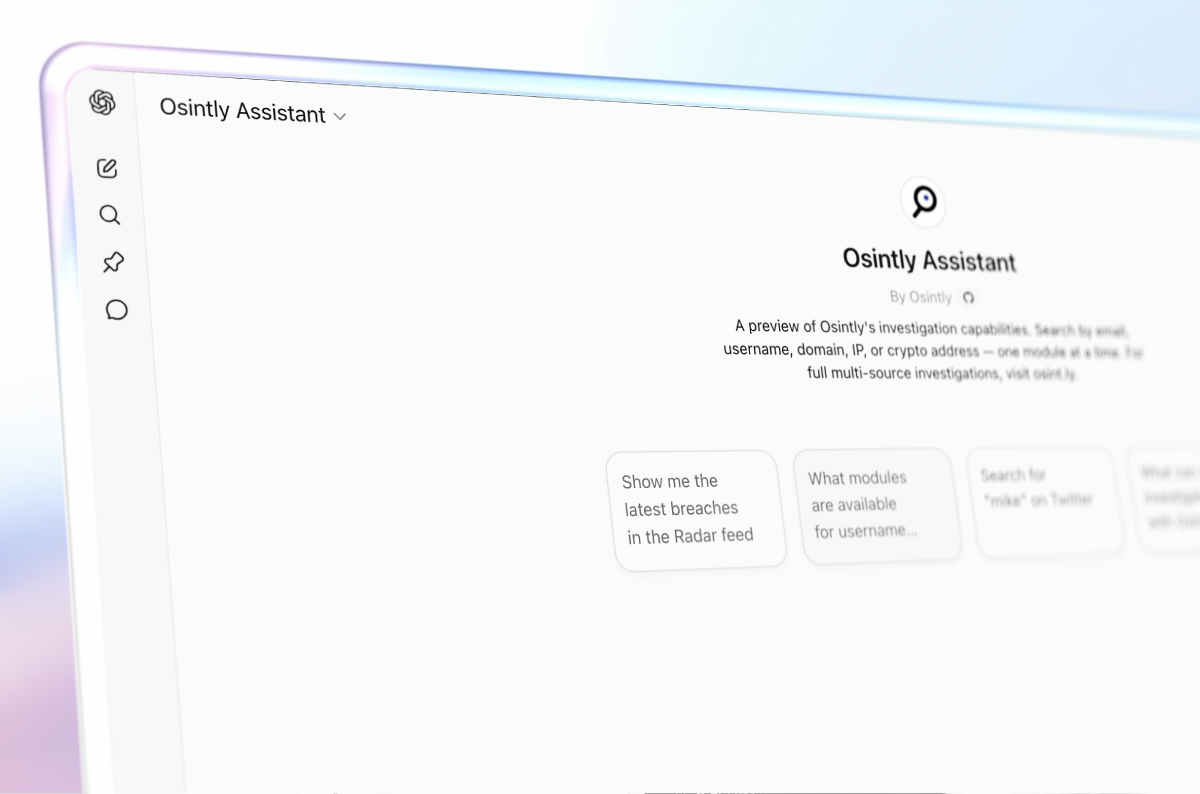
Ask OSINT questions, browse breach intelligence, and run module lookups — directly inside ChatGPT.

Announcements
One integration surface for search, real-time SSE streaming, normalized results, leak providers, webhooks, and BYOK orchestration.
1,550+ ready-to-use OSINT modules covering people, companies, domains, emails, and more.
Everything you need to integrate Osintly into your workflow, from quick start to advanced APIs.
Connect with thousands of OSINT investigators. Share techniques, ask questions, collaborate.
Tutorials, case studies, and insights from our team of open source intelligence specialists.
1,550+ OSINT modules. AI analyst built-in. Real-time data. Everything you need in one place.